
Properties of Jujube fruit خواص میوه عناب

درباره سایت
آخرین مطالب
امکانات وب
Female sex hormones, or sex steroids, play vital roles in sexual development, reproduction, and general health.
Sex hormone levels change over time, but some of the most significant changes happen during puberty, pregnancy, and menopause.They help to relay messages between cells and organs and affect many bodily functions. Everyone has what are considered “male” and “female” sex hormones.
What hormone increases female sexual behavior?
Both estradiol and testosterone have been implicated as the steroid critical for modulating women's sexual desire. By contrast, in all other female mammals only estradiol has been shown to be critical for female sexual motivation and behavior.
Which female hormone affects mood?
It's clear that estrogen is closely linked with women's emotional well-being.
Depression and anxiety affect women in their estrogen-producing years more often than men or postmenopausal women.
Types of female sex hormones
The two main female sex hormones are estrogen and progesterone. Although testosterone is considered a male hormone, females also produce and need a small amount of this, too.
Estrogen
Estrogen is the major female hormone. The lion’s share comes from the ovaries, but small amounts are produced in the adrenal glands and fat cells. During pregnancy, the placenta also makes estrogen.
Estrogen plays a big role in reproductive and sexual development, including:
- puberty
- menstruation
- pregnancy
- menopause
Estrogen also affects the:
- brain
- cardiovascular system
- hair
- musculoskeletal system
- skin
- urinary tract
Estrogen levels can be determined by a blood test. While it can vary from person to person, these are what’s considered the normal ranges in picograms per milliliter (pg/mL):
- Adult female, premenopausal: 15-350 pg/mL
- Adult female, postmenopausal: 10 pg/mL
- Adult male: 10-40 pg/mL
Levels will vary greatly throughout the menstrual cycle.

Progesterone
The ovaries produce the female sex hormone progesterone after ovulation. During pregnancy, the placenta also produces some.
The role of progesterone is to:
- prepare the lining of the uterus for a fertilized egg
- support pregnancy
- suppress estrogen production after ovulation
Progesterone levels can be determined by a blood test. Normal ranges are in nanograms per milliliter (ng/mL):
PhaseRange
before puberty0.1–0.3 ng/mL
during first (follicular) stage of menstrual cycle0.1–0.7 ng/mL
while ovulating (luteal stage of cycle)2–25 ng/mL
first trimester of pregnancy10–44 ng/mL
second trimester19.5–82.5 ng/mL
third trimester65–290 ng/mL
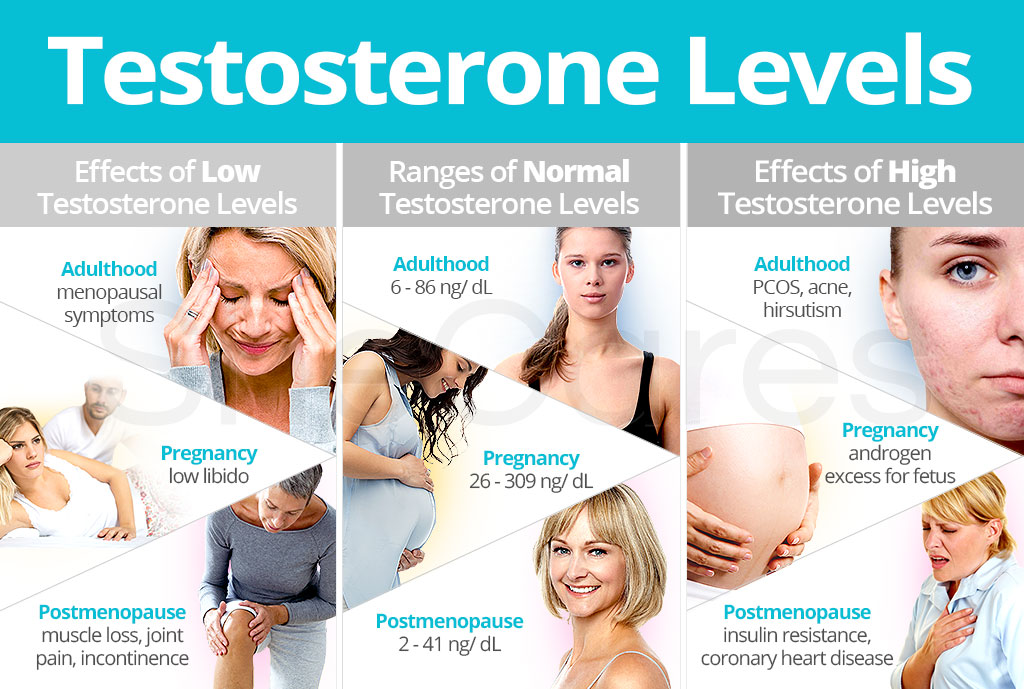
Testosterone
Small amounts of testosterone come from the adrenal glands and ovaries. This hormone plays a role in several body functions, including:
- sexual desire
- regulation of the menstrual cycle
- bone and muscle strength
A blood test can determine your testosterone level. The normal range for females is 15 to 70 nanograms per deciliter (ng/dL).
The roles your hormones play change over time
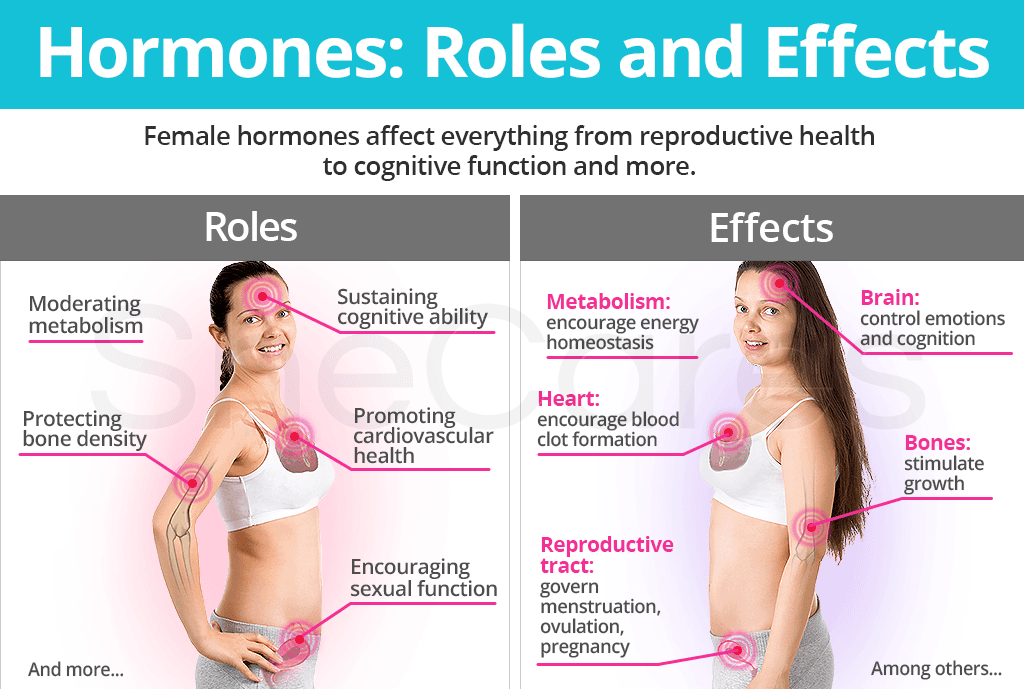
Female sex hormones are integral to many body functions. But your hormonal needs change a great deal as you leave childhood and enter puberty.
They also change dramatically if you become pregnant, give birth, or breastfeed. And they continue to change as you near menopause.
These changes are natural and expected.
Puberty
Everyone is different, but most females enter puberty between the ages of 8 and 13. And it all happens because of hormones.
The luteinizing hormone (LH) and follicle-stimulating hormone (FSH) are produced in the pituitary gland. Production increases at puberty, which in turn stimulates the sex hormones — especially estrogen.
This increase in female sex hormones results in:
- the development of breasts
- the growth of pubic and armpit hair
- an overall growth spurt
- an increase in body fat, especially in the hips and thighs
- the maturation of the ovaries, uterus, and vagina
- the start of the menstrual cycle
Menstruation
The first menstrual period (menarche) happens about two to three years after the breasts begin to develop. Again, it’s different for everybody, but most females get their first period between the ages of 10 and 16.
Follicular phase
Every month, the uterus thickens in preparation for a fertilized egg. When there’s no fertilized egg, estrogen and progesterone levels stay low. This prompts your uterus to shed its lining. The day you start to bleed is day 1 of your cycle, or the follicular phase.
The pituitary gland starts to produce a little more FSH. This spurs growth of follicles in your ovaries. Within each follicle is an egg. As sex hormone levels drop, only a single, dominant follicle will continue to grow.
As this follicle produces more estrogen, the other follicles break down. Higher levels of estrogen stimulate an LH surge. This phase lasts about two weeks.
Ovulatory phase
Next comes the ovulatory phase. LH causes the follicle to rupture and release the egg. This phase lasts about 16 to 32 hours. Fertilization can only occur for about 12 hours after the egg has left the ovary.
Luteal phase
The luteal phase starts after ovulation. The ruptured follicle closes and the production of progesterone increases. This gets the uterus ready to receive a fertilized egg.
If that doesn’t happen, estrogen and progesterone decrease again and the cycle starts all over.
The entire menstrual cycle lasts around 25 to 36 days. Bleeding lasts between 3 and 7 days. But this, too, varies quite a bit. Your cycle may be quite irregular for the first few years. It can also vary at different times of your life or when you use hormonal contraceptives.

Sexual desire and contraception
Estrogen, progesterone, and testosterone all play a role in female sexual desire — also called libido — and sexual functioning. Due to hormonal fluctuations, females are generally at the peak of sexual desire just before ovulation.
There’s generally less fluctuation in libido if you’re using hormonal birth control methods, which affect hormone levels. Your libido may also fluctuate less after menopause.
Undergoing surgery to remove your adrenal glands or ovaries cuts down on testosterone production, which can cause a drop in your libido.
What are the symptoms of low estrogen levels?
The symptoms associated with low estrogen in your reproductive years overlap with common symptoms associated with menopause and postmenopause. Your symptoms will depend on what’s causing your low estrogen levels.
Signs of low estrogen include:
- Dry skin.
- Tender breasts.
- Weak or brittle bones.
- Trouble concentrating.
- Moodiness and irritability.
- Vaginal dryness or atrophy.
- Hot flashes and night sweats.
- Irregular periods or no periods (amenorrhea).
- Weight gain, especially in your belly.
- Headaches before or during your period.
- Decreased sex drive and painful intercourse (dyspareunia).
- Feeling fatigued and having trouble sleeping (insomnia).
Reference:
- healthline.com/health/female-sex-hormones
- ncbi.nlm.nih.gov/pmc/articles/PMC4720522
- webmd.com/women/estrogen-and-womens-emotions
- my.clevelandclinic.org/health/diseases/22354-low-estrogen
برچسب:
نویسنده: کیانوش کریمی